Anthropic and Gates Foundation Commit $200M to Claude
Four-year, $200M program will fund Claude credits, grants and technical support for health, education and development
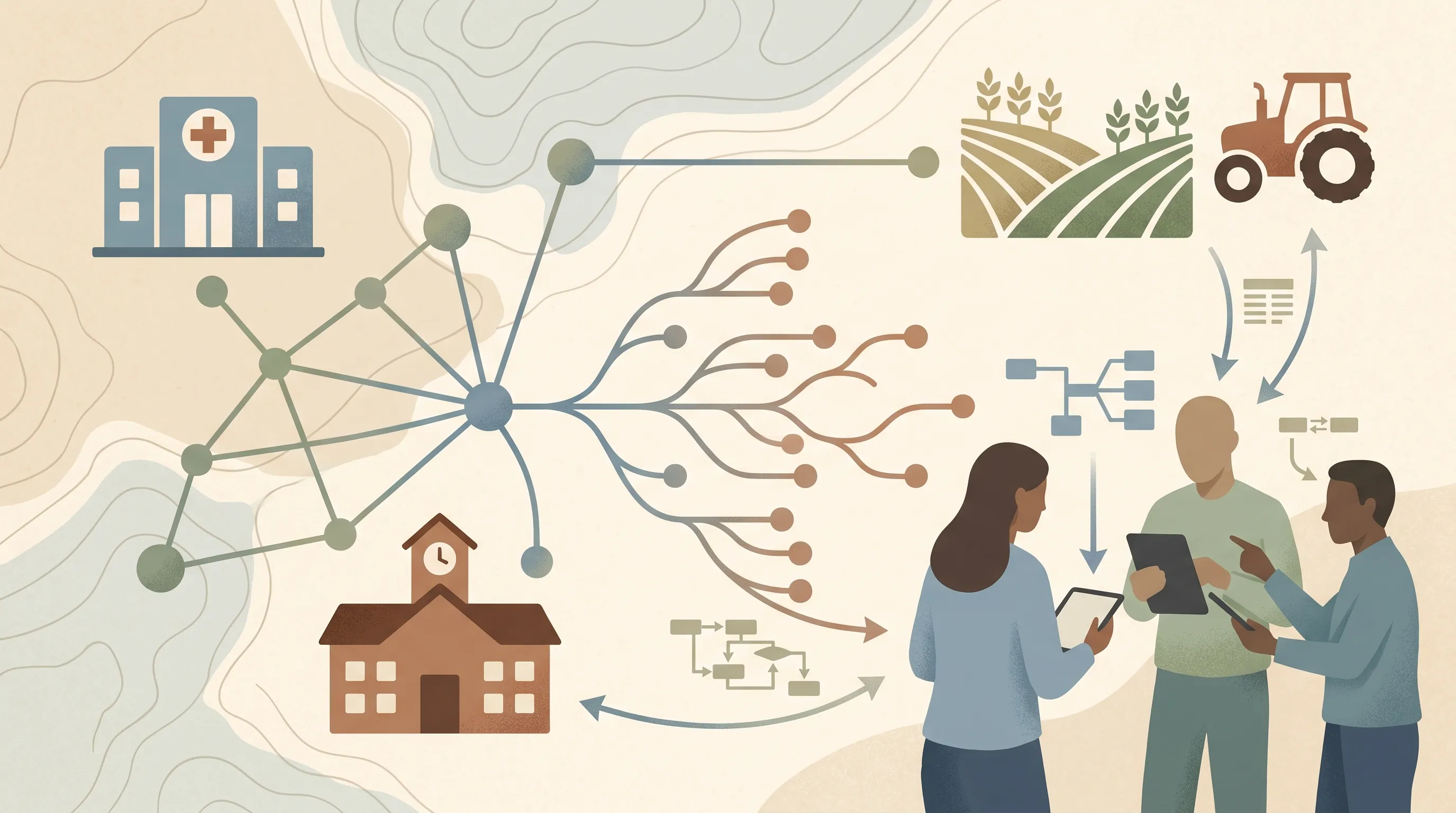
An illustration depicts individuals with digital tablets analyzing a branching network that connects institutions across healthcare, education, and agricultural sectors. © The GPU Trade Inc 2026
Anthropic and the Bill & Melinda Gates Foundation announced a four-year, $200 million partnership to deploy the company’s Claude AI in global health, education, agriculture and economic-mobility programs.
The package combines grant funding, prepaid Claude usage credits and direct technical support from Anthropic’s teams, with the two organizations saying the mix is meant to build durable, reusable tools rather than short pilots. Officials told reporters that Anthropic’s contribution leans on credits and staff time while the Gates Foundation will deliver grant funding and program design.
Planned work spans clinical and life-science research tools, teacher-assist systems, agriculture guidance for smallholder farmers and efforts to boost economic opportunity in underserved communities. Both groups emphasized language access and locally relevant design as priorities for the program.
The move follows other philanthropic efforts to put frontier models into public-sector settings; Reuters noted a separate January pact the Gates Foundation made with OpenAI to support clinics and communities in Africa. The Anthropic deal is pitched as a larger, vendor-led bet on public goods tied directly to a single advanced model.
For Anthropic, the agreement represents a major public-good investment from a high-end model vendor as companies broaden both commercial and philanthropic plays in AI. Industry reporting framed the commitment as part of a trend where model companies pair product access with funding to reach low-margin social sectors.
The Gates Foundation said the partnership will fund shared resources — open datasets, evaluation benchmarks and deployment toolkits — intended for governments, NGOs and researchers to use and adapt. The foundation described the approach as country-led integration, not one-size-fits-all tech transfers.
Anthropic positioned the work as an extension of its ‘beneficial deployments’ efforts, aiming to back real-world projects with engineering support rather than leaving partners to stitch together APIs alone. Company materials describe the technical support as engineering integration, fine-tuning assistance and help building governance processes.
Experts and advocates say the plan could accelerate useful tools — like decision-support for clinicians or low-cost tutoring for teachers — but they also flagged risks around accuracy, bias, procurement and long-term maintenance in low-resource settings. Reporters noted concerns that AI could widen inequities unless governance and capacity are built into deployments.
The deal arrives as Anthropic rapidly scales its commercial footprint and compute arrangements; the company closed a large funding round and has struck deals to expand training and inference capacity, signaling it can support higher-volume public deployments. Those business developments help explain why a vendor would commit substantial credits and staff to multi-year development work.
Practically, Gates Foundation staff will work with country partners to design program goals and measure impact, while Anthropic will supply model access and engineer integrations so tools can run in real environments and be audited. Officials described success metrics that emphasize reuse, localization and measurable service improvement rather than raw usage numbers.
If the partnership hits its targets, it could produce public goods — benchmark datasets, multilingual models tuned to local contexts and open evaluation tools — that other organizations can adopt without repeating costly pilots. That outcome would mark a shift from one-off demos toward durable infrastructure for development work.
Over the next four years, the initiative will be watched as a test case for whether frontier model vendors can responsibly and sustainably channel commercial-grade AI into public-sector problems at scale. Observers say transparent reporting, independent evaluation and community involvement will determine whether the program reduces gaps or risks creating new dependencies.