Broadcom Signs Long‑Term TPU Pact with Google
SEC filing: Broadcom will design TPUs through 2031; Anthropic gets ~3.5 GW from 2027
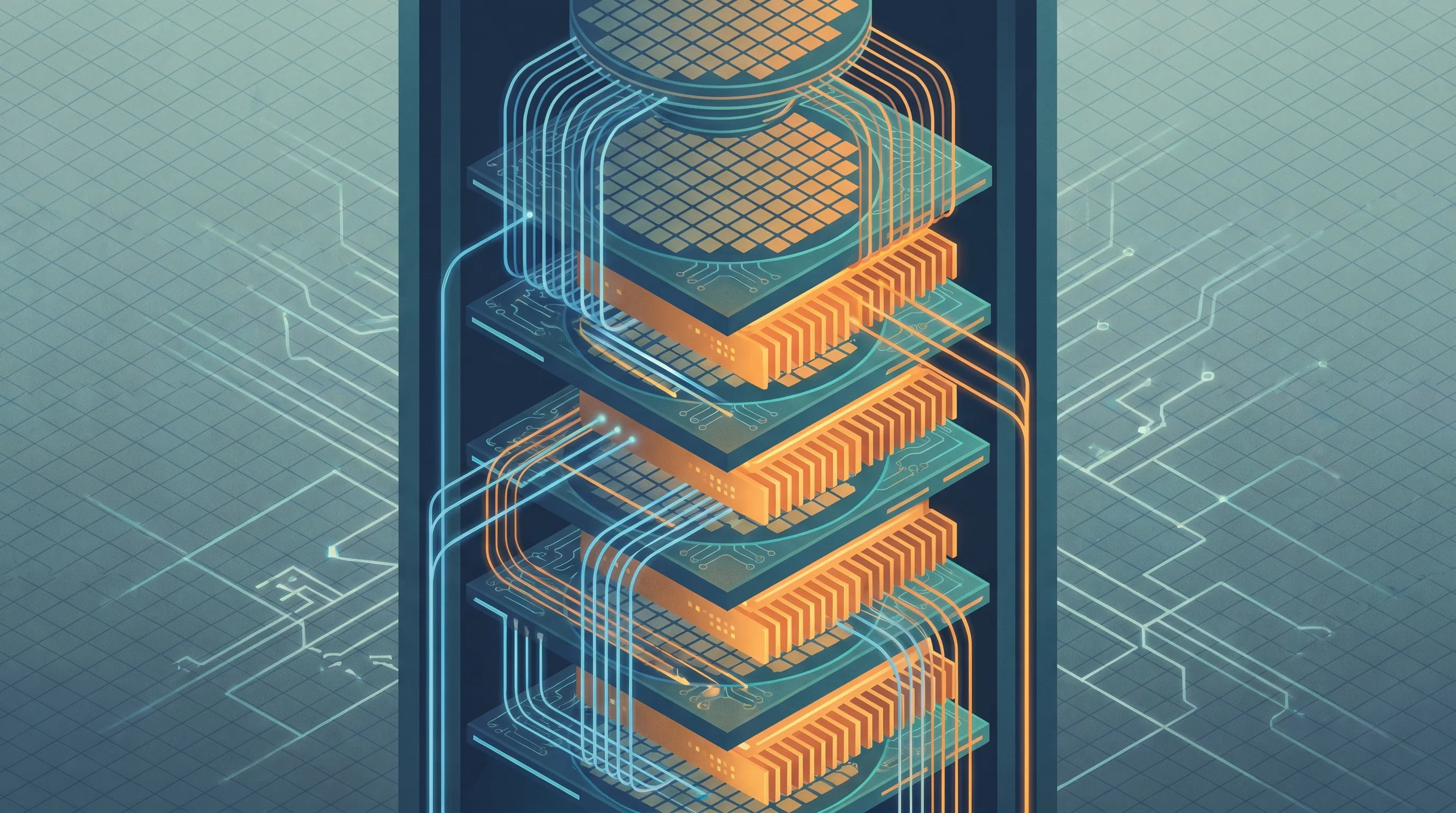
An isometric digital rendering shows a vertically stacked computing system featuring layered circuit boards, orange heat sinks, and illuminated wiring. © The GPU Trade Inc 2026
Broadcom disclosed in a Securities and Exchange Commission Form 8‑K that it has entered a long‑term agreement to design and supply custom Tensor Processing Units (TPUs) for Google’s future generations of AI accelerators, with related supply assurances running through 2031.
The 8‑K also says Broadcom will act as a supplier of networking and other components used in Google’s next‑generation AI racks under a Supply Assurance Agreement that can run “through up to 2031.”
Separately, Broadcom, Google and Anthropic expanded their strategic collaboration so that, beginning in 2027, Anthropic will access through Broadcom approximately 3.5 gigawatts of next‑generation TPU‑based compute capacity, the filing adds. The 8‑K makes clear that Anthropic’s consumption of that capacity depends on its continued commercial success.
The Form 8‑K was filed April 6, 2026, formalizing details that had been reported in market coverage in recent weeks and giving investors an official disclosure of the arrangements. The filing includes the standard caution that the statements are forward‑looking and subject to risks.
Industry coverage and follow‑up reporting place the Broadcom pact in the context of a string of hyperscaler deals that have turned the company into a regular partner for custom AI silicon and rack systems, not just a component vendor. SDxCentral, NextPlatform and other outlets say Broadcom has been moving toward a chief systems role on TPU and XPU projects.
Analysts and trade reporters describe the 8‑K as deepening the industrial ties between hyperscalers and bespoke semiconductor firms, shifting more design and integration work into long‑term supply relationships instead of one‑off buys from commodity GPU vendors. Commentators frame the pact as part of a broader industry pivot toward tailor‑made accelerators for large AI models.
The market responded quickly to the disclosure: Broadcom shares moved on the news and analysts from banks such as Bank of America and others updated models that assume multi‑year revenue from these infrastructure contracts. Reporting has discussed multi‑billion‑dollar revenue potential tied to multi‑gigawatt capacity commitments.
Anthropic’s expanded TPU access builds on prior arrangements with Google Cloud. Reporting from late 2025 noted Anthropic’s commitment to build to multiple‑gigawatt scale and earlier Google Cloud agreements that were expected to deliver over 1 gigawatt of TPU capacity in 2026. The new 3.5 GW figure announced in the 8‑K is additive and aimed at scaling training and inference for larger Claude models.
Some outlets and analysts have tried to map these capacity commitments to revenue and power demand, and to compare them with other large hardware deals in the sector. A number of estimates circulated after Broadcom’s disclosure, though the 8‑K itself does not disclose dollar values or per‑year delivery schedules.
On technical details, trade reporting has suggested Broadcom will help architect successive TPU generations and related rack networking, potentially for designs sometimes labeled in reporting as next‑generation TPU v7 or v8, though the public 8‑K stops short of naming chipset versions and focuses on the scope and timing of supply and access.
The scale of the announced capacity and the multi‑year supply assurances raise practical questions for data center planning, power procurement and financing. Broadcom’s filing notes the parties are in talks with operational and financial partners as part of the deployment, and industry coverage highlights how multi‑gigawatt AI commitments are now a factor in grid and real‑estate planning.
The 8‑K closes with a standard cautionary note about forward‑looking statements and risk factors, a reminder that the commitments are legally disclosed but still subject to change as technology, commercial performance and partner negotiations evolve. Observers say the agreement crystallizes Broadcom’s role in hyperscale AI infrastructure — a shift worth watching for competition, supply chains and where large language model builders place future workloads.