Dell AI Factory Expands with NVIDIA and New PowerEdge XE
Dell debuts liquid‑cooled PowerEdge XE servers, PowerRack racks and a wide partner slate at Dell Technologies World
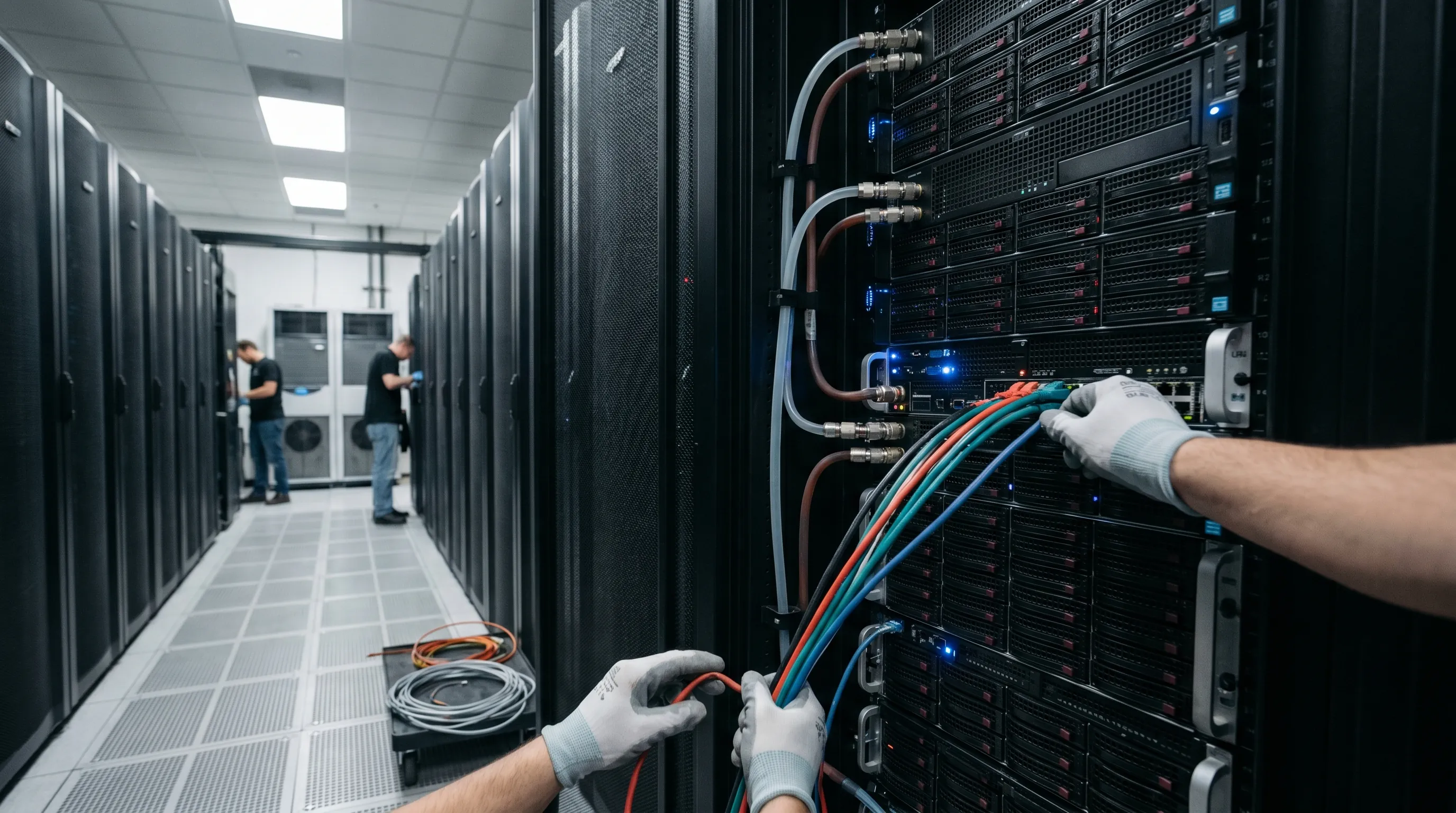
Technicians wearing gloves connect networking cables to a server rack while other personnel work down the data center aisle. © The GPU Trade Inc 2026
At Dell Technologies World on May 18, 2026, Dell unveiled a major expansion of its Dell AI Factory with NVIDIA, introducing new liquid‑cooled PowerEdge XE servers, a turnkey PowerRack rack portfolio and a broad partner ecosystem intended to deliver production AI on premises and in hybrid clouds.
Michael Dell and partners framed the announcements around what the company calls agentic AI — systems that act on behalf of users — arguing enterprises will run those systems on hybrid and on‑prem stacks to keep data, control and governance local.
The hardware highlights are several new PowerEdge XE models built for liquid cooling and dense GPU configurations, with Dell positioning the servers for training, fine‑tuning and inference at enterprise scale. Dell tied the refresh to NVIDIA’s latest rack architectures and to its own integrated management stack.
Dell also introduced PowerRack, a factory‑integrated, rack‑scale offering that bundles compute, networking and storage into turnkey systems meant to speed deployments. Dell said PowerRack for compute is available now, while networking and storage variants follow later in 2026.
NVIDIA remains a central partner: Dell described the Dell AI Factory with NVIDIA as a combined hardware and software platform that pairs its liquid‑cooled PowerEdge XE racks with NVIDIA GB‑class rack accelerators and Rubin architecture to meet performance and efficiency needs. The tie strengthens an existing multi‑year collaboration between the vendors.
Dell also broadened model and software access through an extended partner slate. Announcements included Google’s Gemini 3 Flash running on Google Distributed Cloud on PowerEdge XE9780 systems, SpaceXAI’s Grok models integrating for on‑prem deployments, ties to Hugging Face and exploration with OpenAI on Codex connections to Dell’s AI stack.
A notable enterprise pairing was with Palantir: the companies said they will deliver an on‑premises AI operating system that runs Palantir Foundry and Ontology on Dell AI Factory infrastructure to turn fragmented data into operational AI workflows under customer control. Dell described GPU‑backed nodes for training and CPU control planes for Foundry services.
Dell presented customer examples and partner pilots to underline traction. Mistral and other AI firms are already using Dell’s rack‑scale, liquid‑cooled offerings for LLM training and research, and Dell said the refreshed stack aims to reduce the time from experimentation to production.
Market analysts and trade coverage positioned the moves as Dell doubling down on the argument that many enterprises will choose hybrid or on‑prem infrastructure for regulated or data‑sensitive AI workloads rather than migrating everything to public cloud providers. Dell’s messaging emphasized governance, latency and cost predictability as drivers.
On networking and scale, Dell promoted PowerRack networking featuring high switching capacity intended to accelerate AI fabric rollouts, and integrates the latest high‑throughput switches to support rack‑scale training clusters and dense GPU interconnects. Dell said the integrated approach can shorten deployment time and operational complexity.
Dell provided a practical timeline: PowerRack compute is shipping now, networking modules will be available in September 2026 and storage integrations will follow in the second half of 2026. Management software updates — including Dell Integrated Rack Controller and OpenManage Enterprise releases — were slated for May 2026.
The overall pitch at Day One of Dell Technologies World was straightforward: assemble tightly integrated racks, pair them with a broad partner ecosystem and run agentic AI where the data lives. For enterprises weighing cloud versus on‑prem tradeoffs, Dell’s announcements aim to make the latter a simpler, faster option for production AI while keeping governance and control in house.