Dell becomes OpenAI's on-prem channel - why it matters
OpenAI and Dell will let enterprises host Codex and other deployments locally, reshaping vendor roles
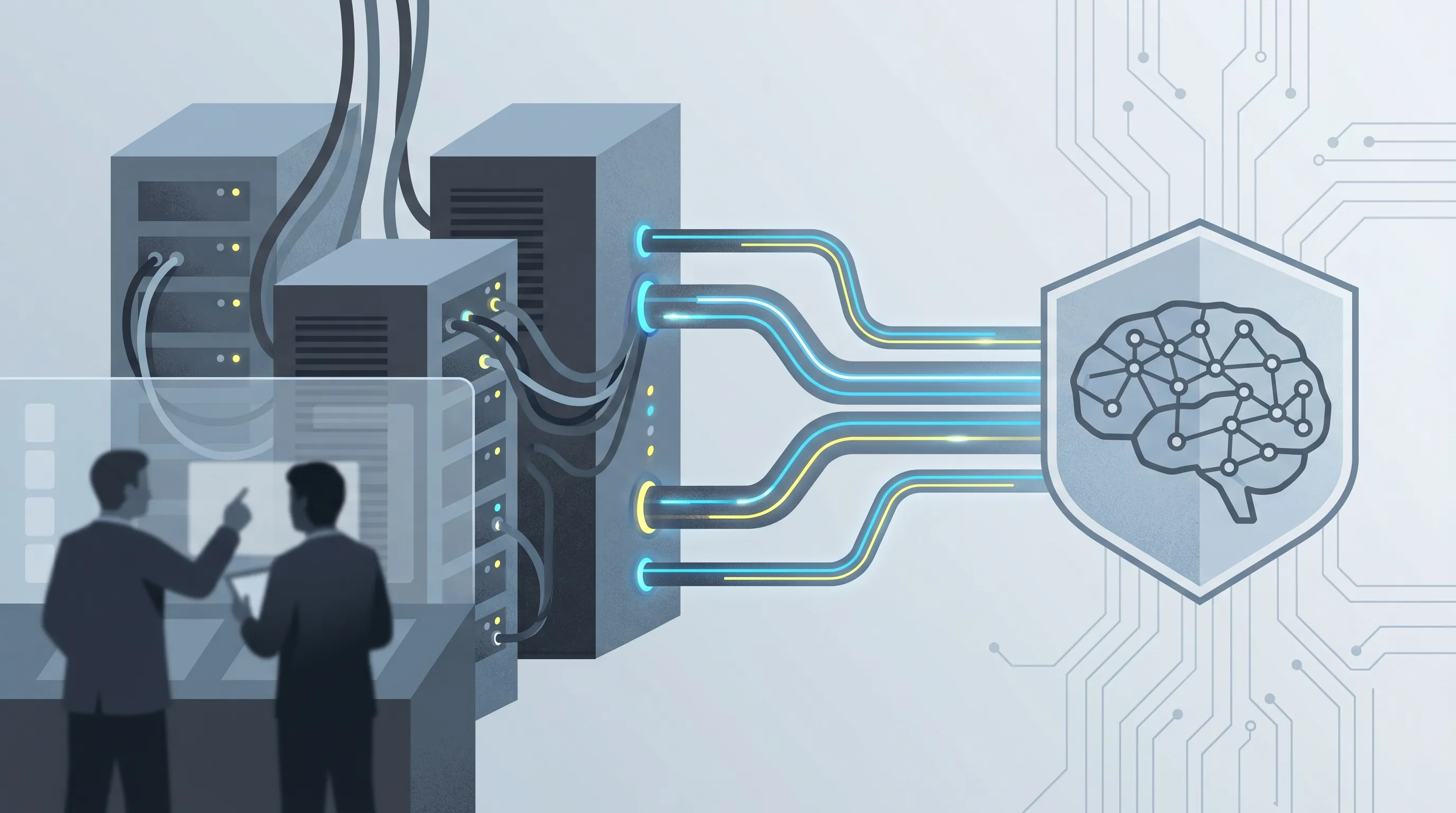
Two silhouetted figures analyze a transparent display near server racks connected by glowing cables to a shielded neural network. © The GPU Trade Inc 2026
On May 18–19, 2026, OpenAI and Dell announced a partnership to bring OpenAI’s Codex and related enterprise deployments into hybrid and on‑premises enterprise environments through Dell’s AI platform.
Under the deal, OpenAI’s Codex will integrate with Dell AI Factory and the Dell AI Data Platform, giving customers a vendor path to host models and manage pipelines where their data lives.
OpenAI says the integration will let Codex and ChatGPT Enterprise “interface with AI Factory to prepare data, manage systems of record, run tests, and deploy AI applications” against on‑premises Dell infrastructure, positioning the offering for regulated workloads.
The announcement came as Dell framed its broader 2026 strategy around distributed AI: Dell showcased the AI Factory, new PowerEdge XE servers and expanded model availability at Dell Technologies World, and it is packaging multiple frontier models for hybrid use.
For large enterprises—especially in finance, healthcare and government—the ability to run frontier models on prem answers immediate concerns about data residency, auditability and compliance that public cloud deployments struggle to satisfy. Analysts and industry briefs pointed to these buyers as prime targets for the Dell‑OpenAI play.
The practical effect is a shift in channel dynamics. By wiring OpenAI’s models into an OEM’s on‑prem stack, system integrators and original equipment manufacturers gain a clearer pathway to package frontier models into compliance‑friendly, vertically tailored offerings. That creates new opportunities for SIs to own integration, customization and long‑term operations.
That does not make cloud providers irrelevant. Public clouds still offer elastic scale, global availability, and managed services that many enterprises need for bursty workloads, model training and multi‑region resilience. Dell’s approach instead reframes cloud and on‑prem as complementary tiers in an enterprise AI stack.
Observers say the deal formalizes a route for enterprises that want frontier models but must keep sensitive data in‑house. The arrangement also dovetails with OpenAI’s broader push toward deployment partners and a Deployment Company model that supports managed rollouts at scale.
For SIs, the opportunity is operational as much as technical: packing models with canned data pipelines, governance controls, observability and support contracts converts an experiment into a repeatable product. For OEMs such as Dell, it lets them sell bundled hardware, software and services that lock in longer lifecycle revenue.
But the approach raises several open questions. Who patches and certifies model updates inside locked‑down customer sites; how will licensing and liability be handled; and what standards will auditors accept for evaluation and provenance of outputs? These operational details will determine whether on‑prem frontier deployments scale beyond early adopters.
There are competitive implications as well. Microsoft, Google and other hyperscalers remain important partners for many enterprises and offer their own models and hybrid clouds. Dell’s role as a distribution and integration channel for OpenAI reshapes options, making it easier for CIOs to combine OEM on‑prem stacks with one or more cloud providers in a multicloud topology.
For CIOs and procurement teams the takeaway is concrete: vendors can now offer a packaged pathway to run frontier models inside corporate perimeter and private clouds, but contracts and SLAs will need new language for model governance, update cadence and incident response. Watch for detailed service terms and pilot results in the coming quarters.