Early‑2026 Funding Surge Concentrates on AI Infrastructure
Reports show unprecedented early‑year raises, with infrastructure draws driving GPU and datacenter demand
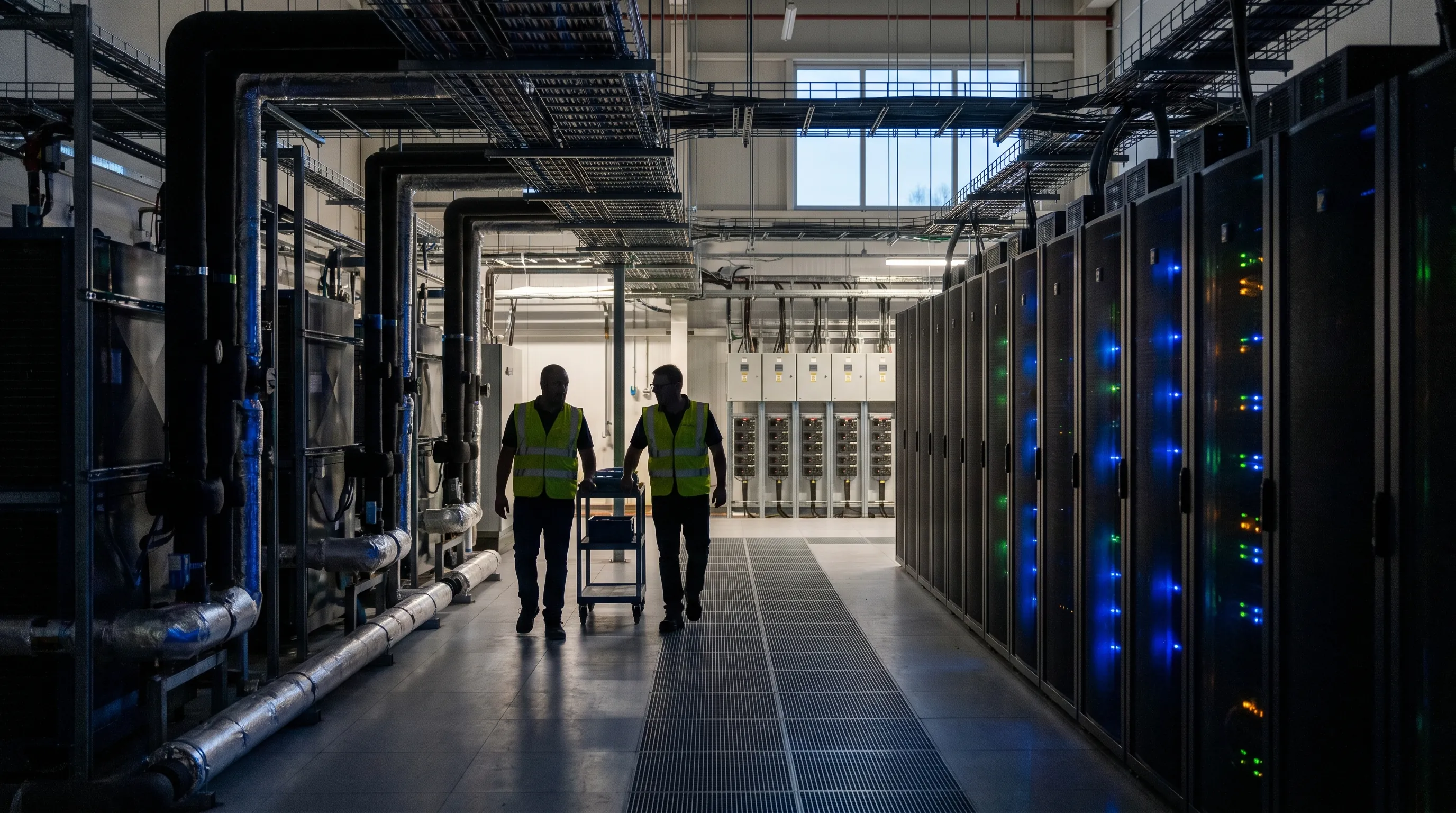
Two workers in high-visibility vests push a cart down a data center aisle flanked by server racks and cooling infrastructure. © The GPU Trade Inc 2026
Investors poured historic capital into AI companies in early 2026, producing one of the fastest funding surges in venture history and reshaping which startups attract the most attention. Data compiled and updated through May 24, 2026 put the scale of those raises well beyond recent norms.
A May 24, 2026 analysis summarized by AI Business Review — drawing on Crunchbase and trade reporting — estimated roughly £220 billion ($~280 billion) flowed into AI startups across January and February 2026 alone. That two‑month figure stunned market watchers because it eclipsed full‑year totals from 2025 in many datasets.
Crunchbase’s Q1 2026 compilation found the quarter set an all‑time record for startup capital, with about $300 billion invested into roughly 6,000 companies and roughly $242 billion — about 80% — going to AI firms. A small number of very large rounds accounted for a large share of that tally.
The concentration was extreme: four frontier labs and a handful of other companies captured a plurality of Q1 capital, pushing late‑stage and growth deals to record totals. Those mega‑rounds reshaped the quarter’s headline statistics and left smaller, non‑AI startups with a sharply reduced share of available venture dollars.
Several outlets and data aggregators — including the May analyses cited above — reported that enterprise AI infrastructure companies captured the lion’s share of that early‑year funding, with some tallies putting the infrastructure slice at roughly two‑thirds of capital deployed in the period. Investors appear to be favoring tools that speed model training, deployment, security and data workflows.
That investor preference has a clear logic: infrastructure and deployment plays convert faster into predictable, enterprise purchasing patterns than many consumer AI experiments. Startups offering specialised chips, model‑training platforms, GPU marketplaces, and inference orchestration attracted outsized rounds because their services map directly to hyperscaler and enterprise procurement needs.
The financial flows are already translating into equipment and power demand. NVIDIA’s May 20, 2026 earnings release reported record revenue driven by data‑center GPUs, with the company’s data center segment posting unusually large quarterly figures — an outcome consistent with sharp near‑term demand for GPU racks and related systems. That revenue surge is one direct market signal that infrastructure funding will materialize as hardware orders and cloud capacity growth.
The compute intensity of leading models means more than chips: investors and operators must plan for cooling, networking, storage and electricity. Independent market analyses published in 2026 underline growing demand for liquid cooling, high‑density power feeds, and specialized memory to support training and inference workloads — investments that follow the venture dollars into infrastructure startups.
Practical examples from early 2026 show the pattern: dozens of large rounds went to companies that sell model‑training orchestration, GPU leasing and custom accelerator hardware rather than to consumer app makers. Crunchbase’s reporting of the quarter’s largest rounds highlights how much capital clustered around foundational compute and hyperscaler‑adjacent plays.
That concentration raises familiar questions about valuation and sustainability. Analysts noted inflated early‑stage valuations in some segments and warned that if enterprise adoption or measurable ROI lags, revaluations could follow. The speed of capital deployment also pressures startups to execute quickly on scale‑dependent plans — a difficult task in a hardware‑intensive market.
For corporate buyers, chipmakers and grid operators, the early‑2026 funding wave alters planning. Cloud providers and large enterprises will likely accelerate capacity commitments and multi‑year procurement decisions to secure GPUs, TPUs and power. Regulators and utilities may also watch closely, since multi‑gigawatt buildouts have local permitting and grid implications that can influence how, where and how fast this infrastructure appears. The funding surge therefore matters beyond startup valuations — it is reshaping where compute lives and who finances it.