EON Spatial OS Unifies XR and Generative AI
EON Reality launches a hardware‑agnostic XR OS that pairs generative content, AI co‑workers and field dashboards
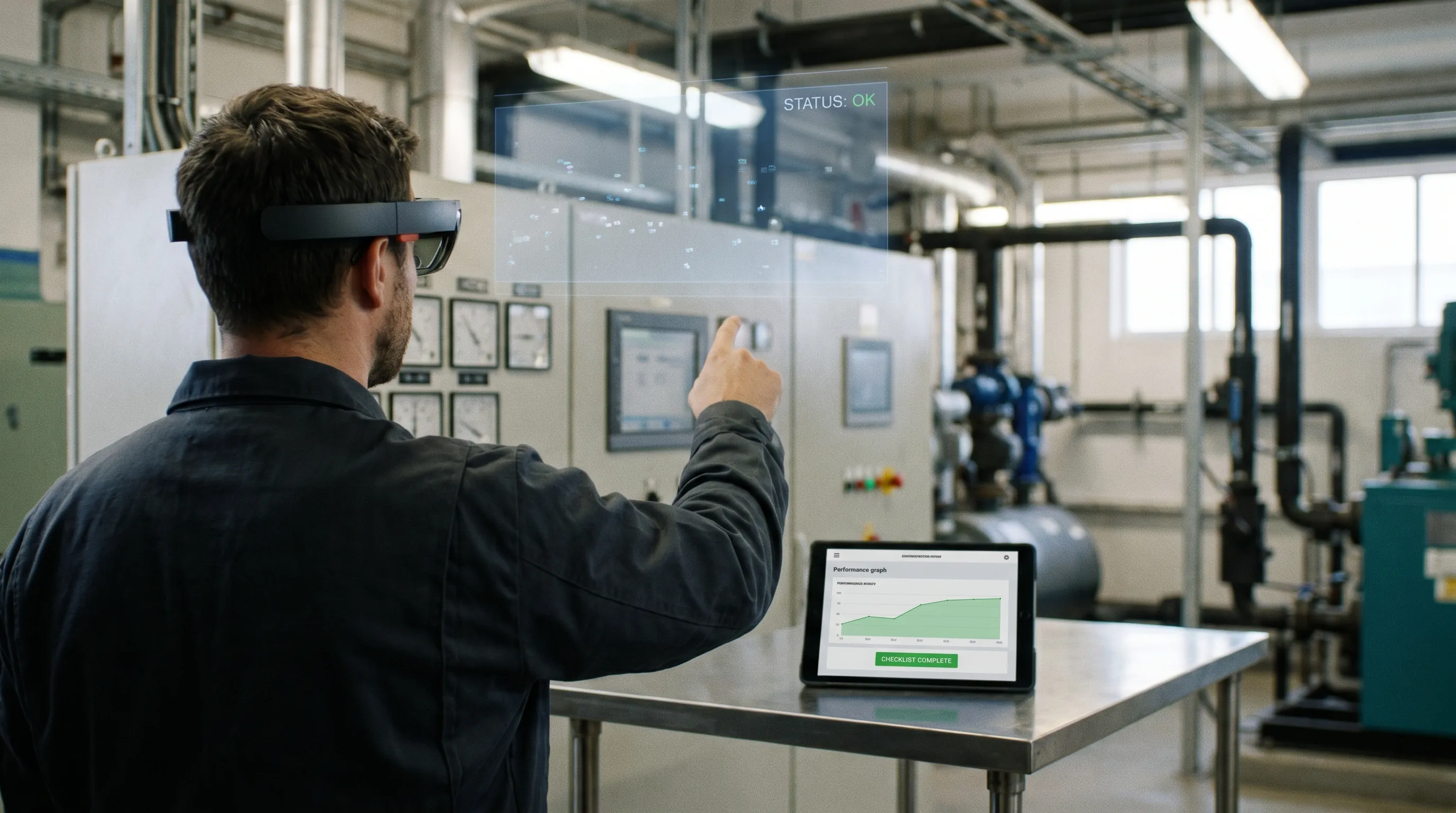
An industrial technician wearing an augmented reality headset interacts with a virtual data overlay near a tablet displaying performance metrics. © The GPU Trade Inc 2026
EON Reality on May 22, 2026 announced EON Spatial OS, a hardware‑agnostic operating system that unifies the company’s generative content engine, real‑time AI co‑workers and field performance dashboards for enterprise XR training and simulation.
The new product packages Genesis 3 — EON’s generative 3D content pipeline — alongside Assist IQ, the company’s always‑on AI co‑worker, and Field IQ, the operations performance layer, with Career Compass workforce intelligence stitched into the same runtime.
EON positions Spatial OS as a single industrial AI layer that sits above any glasses, headset, tablet or web browser, and says it ships today on a range of devices while being pre‑integration ready for several upcoming AR platforms.
Genesis 3 is the generative content factory inside the OS: EON says its Object→World and Photo→Environment pipelines can turn a single photo or scan into spatially anchored knowledge objects, collapsing traditional 3D authoring timelines and costs.
Assist IQ is described as a real‑time AI co‑worker that 'sees what the worker sees' through smart glasses or a tablet, pulls the correct procedure, narrates the next step and verifies completion while logging evidence for audits. The company has emphasized hands‑free guidance, AI photo verification and timestamped audit trails for compliance use cases.
Field IQ binds spatial procedures to live IoT signals from assets, logs near‑misses and first‑time‑fix rates, and surfaces operational analytics to supervisors, creating a tracked path from training to field execution. EON frames the stack as closing a long‑standing gap between learning and real‑world performance.
EON says Spatial OS targets the roughly 2.7 billion deskless workers — technicians, operators and frontline staff in energy, aerospace, healthcare, manufacturing and the skilled trades — where the company argues white‑collar generative AI has not addressed physical‑world execution. The press materials outline use cases that range from valve maintenance on an offshore platform to MRI operator checks in hospitals.
In its announcement EON framed Spatial OS as the industrial counterpart to recent consumer industry language about 'Human 2.0,' quoting founder Dan Lejerskar to draw a line between consumer convenience and industrial economic impact. The company argues industrial spatial AI prevents costly operational failures and moves the P&L.
EON presents the OS as purposely hardware‑agnostic to reduce the 'patchwork' of point tools that typically fragment enterprise training, simulation and field guidance workflows, and to simplify rollouts across mixed device fleets. That architecture also aims to shorten the time from knowledge capture to verified field performance.
The product rollout follows a string of EON releases this spring — including Genesis 3 and other Spatial AI components — and the company highlights its 25‑year track record and broad customer base as a differentiator. EON notes Genesis 3 is already in use across its install base of roughly 4,400 customers in more than 80 countries.
Adoption for enterprises will hinge on several practical questions: how EON integrates customers’ existing SOPs and IoT telemetry, how models are trained on proprietary content, and how the platform handles data governance and regulatory reporting. EON’s product materials promise auditability and verifiable evidence for compliance, but deployments in regulated industries will still require careful validation.
EON Spatial OS is another sign that vendors are packaging spatial computing, generative models and operational analytics into unified stacks aimed at frontline workers rather than only consumer metaverse or entertainment experiences. For enterprises, the value claim is straightforward: faster, cheaper content plus live, verifiable field assistance that ties training to outcomes. The market will judge that claim against pilots and real‑world audits as the platform is put into production.