Intel unveils Starfire: space‑grade Panther Lake SoC
An 18A Panther Lake multi-tile chip for rugged satellite AI and government use
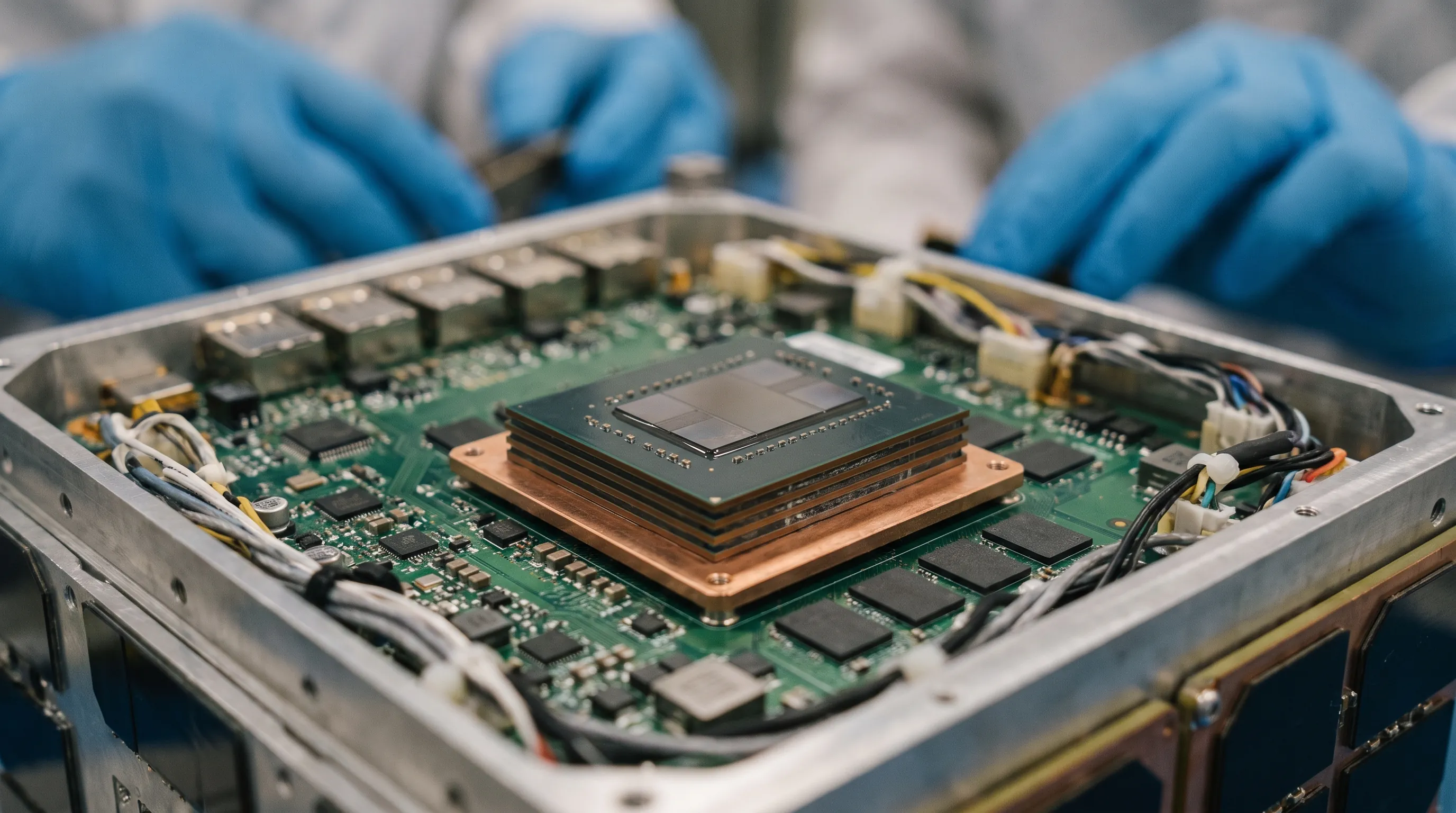
Intel this month introduced Starfire, a space‑grade system‑on‑chip built from Panther Lake building blocks and hardened for orbital use. The design stitches 18A CPU and NPU tiles with an Intel‑3 GPU tile in a Foveros multi‑tile package aimed at government and satellite customers.
The Starfire topology pairs an eight‑core CPU arranged as four performance cores and four efficiency cores with a three‑tile neural processing unit and a four‑core Xe GPU. Intel places the CPU and NPU on its 18A node while the graphics tile is manufactured on Intel‑3.
Intel is shipping Starfire in two tuned SKUs: a low‑power 10 W variant and a higher‑power 35 W version. The two parts deliver roughly 45 TOPS and 75 TOPS of INT8 NPU performance respectively, giving satellites on‑board inference capability without heavy ground processing.
Clock targets differ sharply between the SKUs. The low‑power chip runs P‑cores near 1.0 GHz and E‑cores below 1 GHz, while the performance SKU pushes P‑cores to about 3.1 GHz and the GPU up to 2.0 GHz to reach its upper TOPS figure. Both models include contemporary I/O, such as a dozen PCIe Gen4 lanes and support for LPDDR5 or DDR5 memory.
Starfire is engineered for wide thermal swings and long lives: Intel lists an operating range from −55°C to 125°C and rates the family for a 10‑plus year lifetime. The documentation also references total ionizing dose and single‑event protections, though Intel describes some radiation data as characterization and subject to further qualification.
That specification set marks a big step from the dated chips that have dominated flight systems for decades. For example, legacy rad‑hard processors such as the RAD750 run at only tens to a few hundred megahertz on much older process nodes; Starfire brings modern process density and specialized AI silicon into that market.
On‑board inference is the main technical case Intel and analysts point to: satellites can triage imagery, detect anomalies, and autonomously reduce telemetry needs before downlink, saving bandwidth and speeding decisions. The dedicated NPU plus GPU and CPU in one package let operators balance power, latency, and functionality on orbit.
Intel says Government Technologies will handle Starfire’s customer engagement and domestic manufacturing positioning. The company ties the program to broader U.S. supply‑chain initiatives and claims advantages as a trusted, domestic foundry for leading‑edge logic. Intel has also linked its advanced packaging roadmap to Pentagon programs while noting 18A yield targets will take time.
Practical use cases are straightforward: the 10 W SKU is sized for small spacecraft and CubeSats that need local image or sensor processing, while the 35 W SKU targets larger communications, reconnaissance, and edge compute satellites that can host higher thermal budgets. Intel and observers say development kits and Earth‑bound validation systems will likely appear alongside flight samples.
Experts and reporters note caveats. Leading‑edge nodes like 18A improve density but can be more susceptible to single‑event upsets, meaning designers rely on circuit hardening and software mitigations rather than process alone. Intel’s sell sheet and early docs emphasize characterization and ongoing qualification rather than finished, flight‑qualified certifications.
Intel expects Starfire samples in the third quarter of 2026 and is pitching the chips as a lower‑latency, domestically produced alternative for government programs that need ruggedized AI at the edge. The product signals a broader industry shift: bringing contemporary AI silicon into space systems to shrink latency and cut downlink loads while meeting strict size, weight and power constraints.