NVIDIA's Record Q1: $81.6B from Data-Center AI
Explosive data‑center demand reshapes revenue, reporting and the component chain
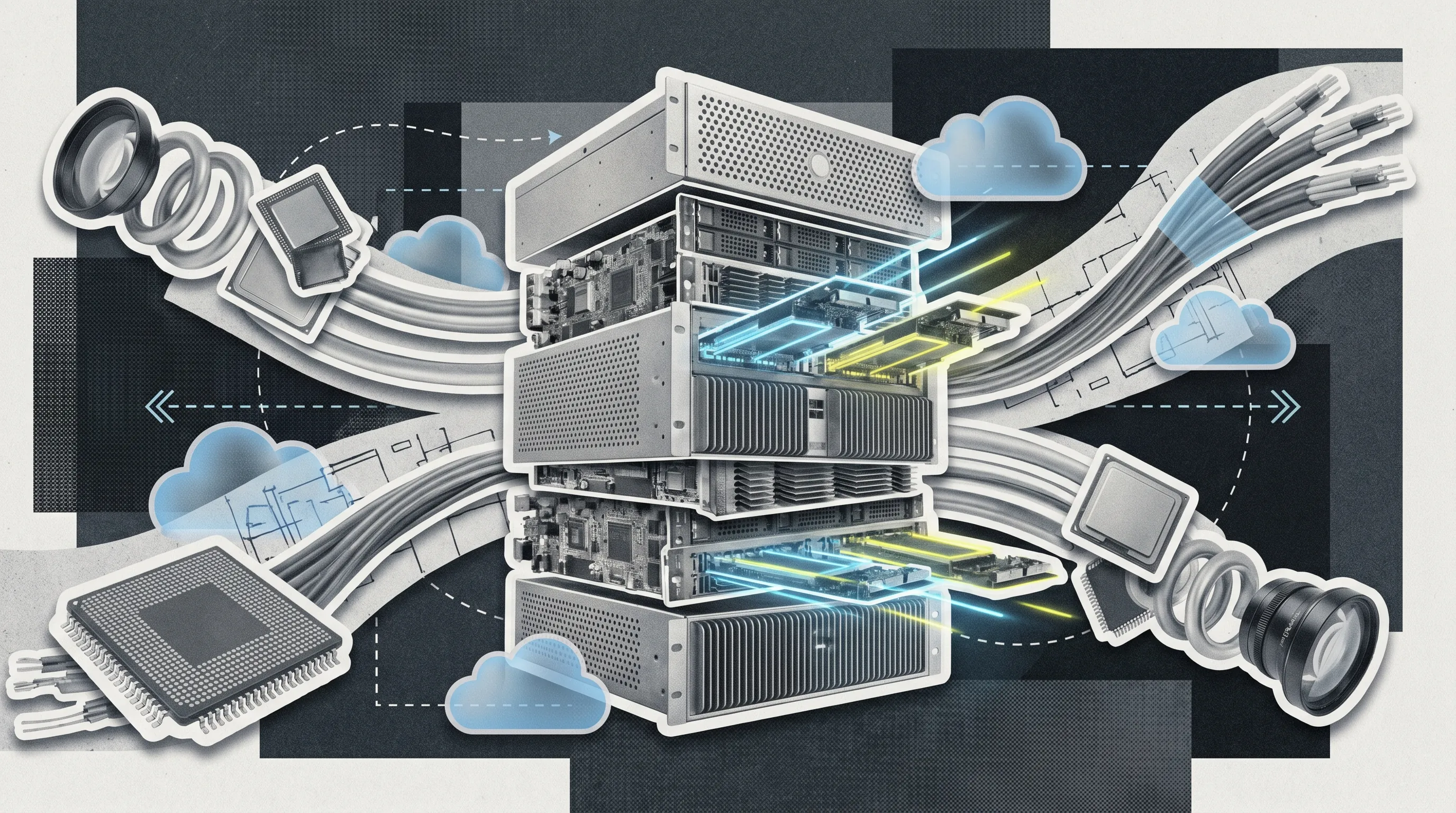
A technical collage depicts a stack of server hardware alongside microchips, data cables, camera lenses, and cloud symbols. © The GPU Trade Inc 2026
NVIDIA reported a staggering $81.6 billion in revenue for the first quarter of fiscal 2027, a 20% sequential increase and an 85% jump year over year for the quarter ended April 26, 2026. The result is the company’s largest quarter on record and a clear sign that AI infrastructure spending remains the dominant growth driver for the firm.
The single engine behind that number was the Data Center platform, which produced record revenue of $75.2 billion — roughly 92% higher than a year earlier and up 21% from the prior quarter. NVIDIA also reported record Data Center networking revenue of $14.8 billion, reflecting heavy demand for switches and high-speed interconnects used alongside its GPUs.
The company announced it will reorganize financial reporting into two market platforms: Data Center and Edge Computing. Within Data Center, NVIDIA will publish two sub-markets — Hyperscale and ACIE (AI Clouds, Industrial and Enterprise) — intended to make the source of demand clearer for investors and customers. The change formalizes the shift from gaming and PCs toward large-scale AI deployments.
NVIDIA’s press release and slides broke down parts of that Data Center demand, showing hyperscalers and large cloud providers as a major buyer group while also flagging a rapid ramp in enterprise and industrial AI “factories.” Third‑party reporting that parsed the company’s tables showed hyperscaler purchases near the high‑$30 billion range and ACIE similarly large, while Edge Computing revenue totaled roughly $6.4 billion. Those sub‑breakouts underline how much of the company’s growth is now driven by cloud and purpose‑built AI centers.
Management paired the blowout results with a bullish outlook. NVIDIA guided to roughly $91.0 billion in revenue for the second quarter, plus or minus 2%, while explicitly saying it was not including any China Data Center compute revenue in that outlook. That caveat sharpened investor focus on geopolitical and regulatory limits to certain markets.
Investors reacted in mixed fashion after hours: shares initially dipped, then rose, and finished with modest moves as traders parsed upside to revenue against higher operating expenses and a complex China picture. Commentators noted the stock’s volatility reflected both excitement for another record quarter and concern about whether such growth is broadly sustainable. Market commentary and after‑hours summaries captured the seesaw trading.
The quarter also reshaped the supplier landscape. NVIDIA highlighted new optical and silicon‑interconnect partnerships and disclosed strategic agreements with vendors working on advanced optics and network fabrics, moves that have immediate implications for suppliers of photonics, switches and cooling systems used in dense AI racks. Those suppliers have seen order flows and share prices react as customers accelerate buildouts.
The scale of the orders is altering component supply chains. High volumes of Blackwell GPUs, NVLink/InfiniBand attachments and associated memory put pressure on foundry schedules, HBM capacity and Ethernet optics. Analysts and industry reporting point to shortages and prioritization of datacenter SKUs over consumer graphics, which is already prompting some OEMs to reallocate production and tweak road maps.
NVIDIA paired the financial surge with shareholder returns: an additional $80 billion repurchase authorization and a hike in its quarterly cash dividend to $0.25 from $0.01 per share. The company also returned roughly $20 billion to shareholders during the quarter through repurchases and dividends. Those moves underscore how the windfall is being used to support stockholder value even as NVIDIA invests in new data‑center platforms.
Analysts said the report confirms a prolonged AI infrastructure cycle but stressed it raises questions about concentration risk. Visible Alpha and other consensus trackers showed high expectations for Data Center revenue and noted that much of NVIDIA’s upside depends on sustained hyperscaler capex and enterprise adoption — both of which can be lumpy. The market is now watching whether customers will keep placing orders at this cadence.
For other chipmakers and networking vendors, NVIDIA’s quarter is a bellwether. Companies that supply optics, switches, DRAM and HBM benefit from larger data‑center buildouts, while PC‑focused suppliers face a slower growth profile. The quarter therefore accelerates an industry pivot toward specialized datacenter inventory and long lead times for high‑end components. Several suppliers publicly reported gains in order activity in the days after NVIDIA’s announcement.
What to watch next: follow‑on orders from hyperscalers, supplier production chatter for HBM and silicon photonics, and China policy on high‑end compute exports. NVIDIA’s December‑to‑April quarter showed how quickly AI compute demand can alter revenue mixes, but sustaining that pace will depend on factory capacity, the pace of enterprise model deployments and geopolitics that affect where certain chips can be sold.