Schiff's Plan: Data Centers to Pay Grid Upgrade Costs
The Energy Cost Fairness and Reliability Act would make large data centers (≈50 MW) cover transmission upgrades or secure power.
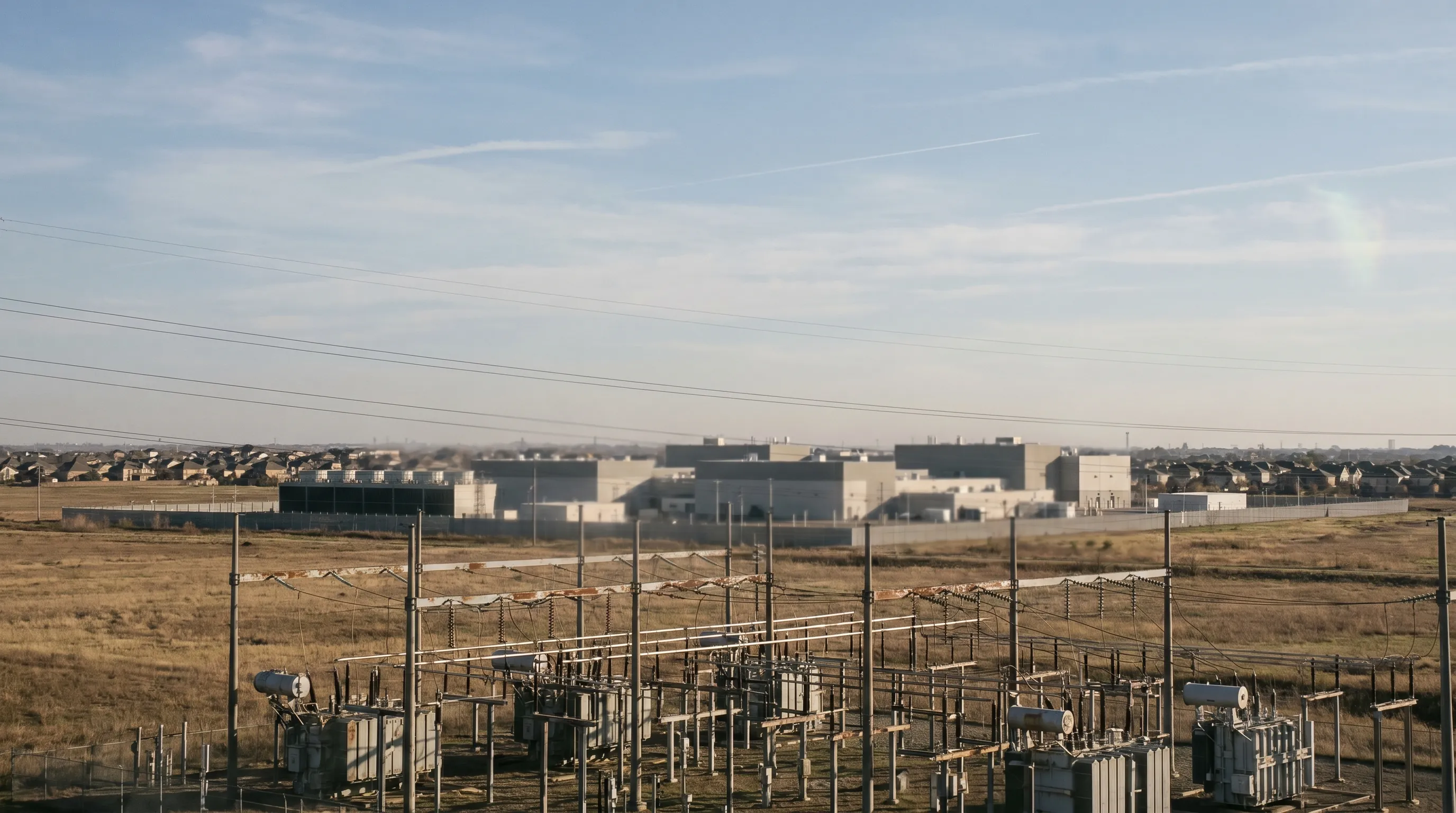
An electrical substation sits in a grassy field with a large data center complex visible in the background. © The GPU Trade Inc 2026
Sen. Adam Schiff unveiled the Energy Cost Fairness and Reliability Act on May 18–19, 2026, proposing that very large data centers either pay for the transmission upgrades they require or secure dedicated power so local customers don’t shoulder the costs.
The bill sets a roughly 50-megawatt threshold, targeting hyperscale AI campuses and other facilities with unusually large peak demand. Above that line, developers would face new federal interconnection rules and financial obligations.
Under the proposal, operators with peak demand over 50 MW would be required to pay 100% of interconnection study expenses and network upgrade costs, and those payments would be nonrefundable, according to the draft text and media summaries. The measure would also forbid utilities from socializing those upgrade costs across other ratepayers.
Schiff’s office framed the bill as enforcing a voluntary White House “ratepayer protection” pledge signed by major tech firms in March 2026, and quoted the senator saying AI growth “cannot come at the cost of consumers or society.” The legislation would also direct FERC to revise transmission rules to allow new arrangements that limit peak demand or let customers bring their own generation.
The measure lands amid a flurry of grid-facing moves by regional operators. PJM — the largest U.S. grid operator — has proposed a 50 MW line and new interconnection models such as “Connect-and-Manage” and behind-the-meter limits to make large loads more visible to planners. PJM has also floated a one-time procurement to bring online tens of gigawatts of new capacity for high-growth regions.
Supporters of federal action say state and local ratepayers in fast-growing data-center corridors already face higher bills or deferred upgrades as utilities plan new lines and substations to serve concentrated demand. Schiff’s bill explicitly aims to stop that cost-shifting.
Industry groups and data-center backers dispute how much of recent price rises should be attributed to the sector. A Data Center Coalition-funded review by E3 found “no quantitative evidence” that data centers historically have been subsidized by other customers—an argument industry advocates are using to push back against mandates.
Still, several major tech firms have already moved toward on-site or contracted generation. Microsoft, Amazon, Google and Meta have announced partnerships, long-term power deals, and even nuclear-focused plans to secure supplies for AI infrastructure—moves that could reduce the impact of Schiff’s requirements on companies that can afford dedicated capacity.
If the bill becomes law, it could reshape siting economics for hyperscalers and so-called neocloud operators by adding upfront project costs or requiring long-term power procurement contracts. That could push some projects to different states, slow timelines, or make smaller, distributed builds more attractive.
Legal and political hurdles remain. Bloomberg Law reported the bill initially lacks GOP co-sponsors, though Schiff’s team said it is in talks with other lawmakers. Any final law would also depend on how FERC, regional grid operators, and state regulators implement new interconnection and cost-allocation rules.
The timing matters: federal regulators and PJM have been moving quickly, with FERC signaled to act on large-load rules and PJM advancing procurement and tariff changes this spring and summer. That regulatory momentum could either blunt or amplify the bill’s effect depending on how new grid rules evolve.
For communities and utilities watching project filings, the bill represents a clarifying test: lawmakers would force a national cost-allocation decision rather than leaving it to local deals and voluntary corporate pledges. Schiff’s proposal aims to make those costs visible and explicitly assigned to the customers who create the new demand.