Self-hosting Kimi K3 Still Costs Millions
Open weights don’t remove the hardware, memory and network bills for a 2.8T model
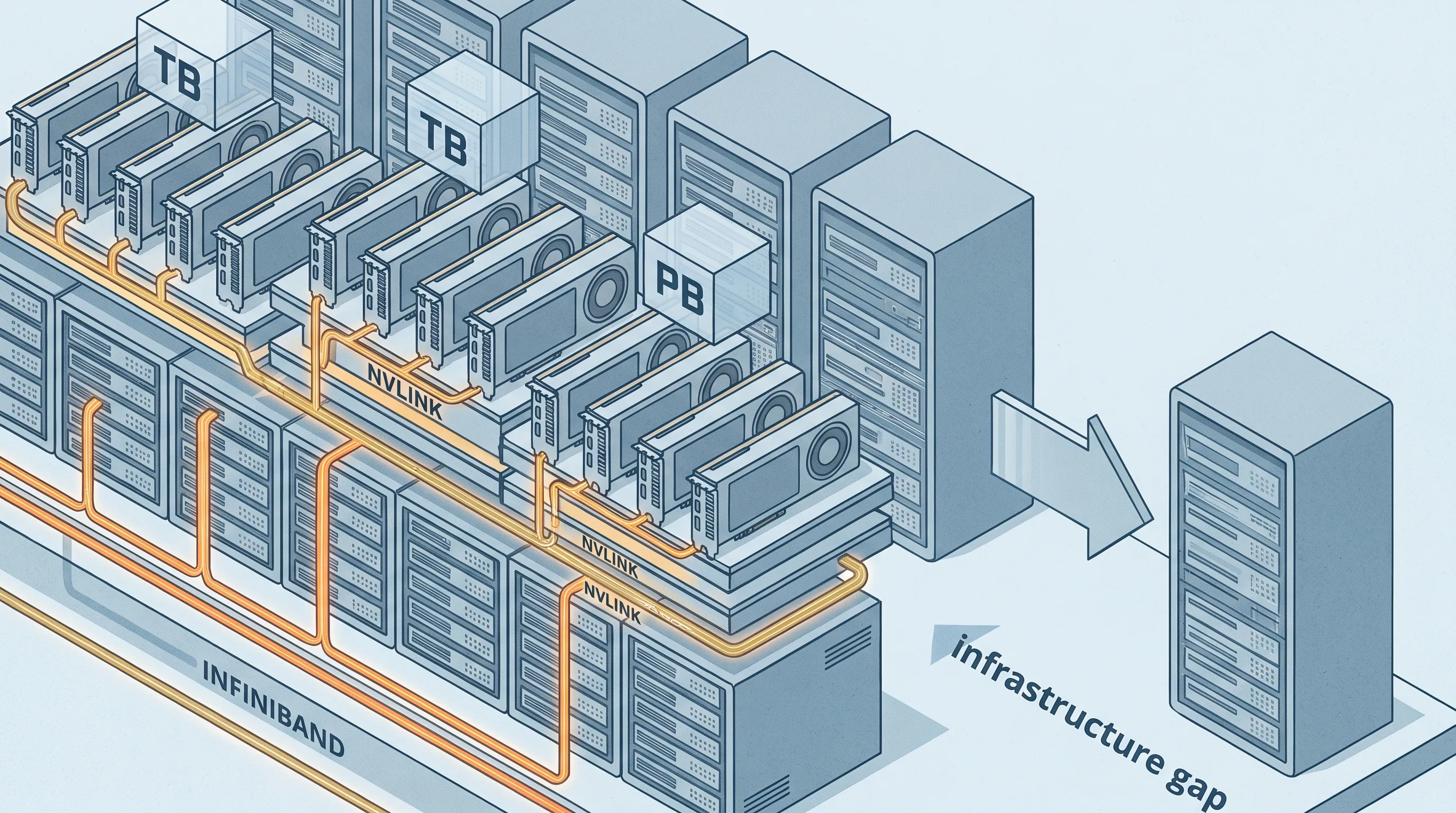
When Kimi K3’s team published the full 2.8‑trillion‑parameter weights, the news felt seismic: the largest open‑weight model available for anyone to download and run. That headline masks a practical reality — the raw files are public, but making K3 into a production inference engine is a different problem.
The published weights use aggressive MXFP4-style quantization, which the community and model hosts say reduces on‑disk weight storage to roughly 1.4 terabytes instead of the many terabytes that FP16 would require. That smaller on‑disk footprint makes the release notable, but it does not erase runtime memory, activation and interconnect needs.
If you converted K3’s 2.8 trillion parameters back to FP16, the simple math shows why the numbers balloon: one parameter in FP16 costs two bytes, so 2.8T × 2 bytes is on the order of 5.6 terabytes of raw parameter memory — before you count optimizer state, KV caches, or activation buffers. That arithmetic underpins why engineers talk in terabytes when planning hardware for models at this scale.
Those terabytes of working memory force one of two choices: pay for a very large, tightly connected GPU cluster where the aggregate GPU HBM holds most of the model, or rely on software that shards and streams parameters across GPU, host memory and NVMe — trading latency for lower peak memory requirements. Both approaches add cost and complexity.
On the ‘big GPU cluster’ side, modern accelerators still ship with tens of gigabytes of HBM per card — NVIDIA’s H100 cards are commonly sold in 80GB or 94GB configurations. Holding multiple terabytes of model state in HBM therefore requires dozens of high‑end GPUs, plus the host servers, chassis and power distribution that go with them. Those line items are expensive.
Independent community estimates that assembling a production‑grade, low‑latency cluster for Kimi K3 inference — including dozens of H100‑class GPUs, NVMe, NICs and enterprise networking — pushes hardware bills into the multimillion‑dollar range. Public writeups have put realistic procurement and integration costs in the roughly $3–4 million neighborhood, not counting operational staff and data‑center space.
Cost isn’t just GPUs. At this scale the interconnect matters as much as raw memory. Inside a node, NVLink or NVSwitch gives very high cross‑GPU bandwidth; between nodes you need RDMA‑capable fabrics like InfiniBand or NDR to avoid starving GPUs. Poor interconnect leads to serialization and idle chips — and that multiplies the effective hardware cost.
Because moving terabytes across networks and between device memories is expensive, open‑weight teams often turn to heterogeneous offload pipelines. Tools like DeepSpeed’s ZeRO‑Inference and ZeRO‑Infinity let engineers span GPU HBM, host RAM and NVMe so a model can run without every parameter sitting in GPU memory. The tradeoff is increased latency, careful orchestration, and a high‑throughput NVMe layer.
That NVMe layer has real engineering demands. For practical throughput you need NVMe arrays with sustained multi‑gigabyte‑per‑second read rates and predictable IOPS, plus software that pre‑fetches model shards and hides IO latency. In practice teams either buy enterprise NVMe at scale or accept long tail latency and throughput cliffs that hurt user‑facing services.
Quantization and smart offload reduce the bill, but they don’t erase it. MXFP4 and similar 4‑bit formats shrink disk and working set sizes substantially, and optimized runtimes can cut memory pressure by moving KV caches and activations to cheaper tiers. Still, production applications often need lower latency and higher QPS than offload pipelines comfortably support without more hardware.
There are also operational costs most groups underestimate: power and cooling for dense GPU racks, the engineering time to debug interconnect topology and sharding, and the cost of reliability engineering when a node drop means reconstructing or reloading terabytes of parameters. These are ongoing costs that add to the upfront capital spend.
The result is a paradox: open weights democratize access to model internals and research‑scale experiments, but day‑one self‑hosting for production inference remains impractical for most teams. For many organizations the sensible path is hybrid: use hosted APIs or managed inference while testing self‑hosted, quantized workflows for specific, high‑value use cases. That keeps data control without committing to a multimillion‑dollar forklift.