Tan Teases Intel-NVIDIA Collaboration
A Carnegie Mellon moment renewed talk of co‑designed CPU/GPU platforms
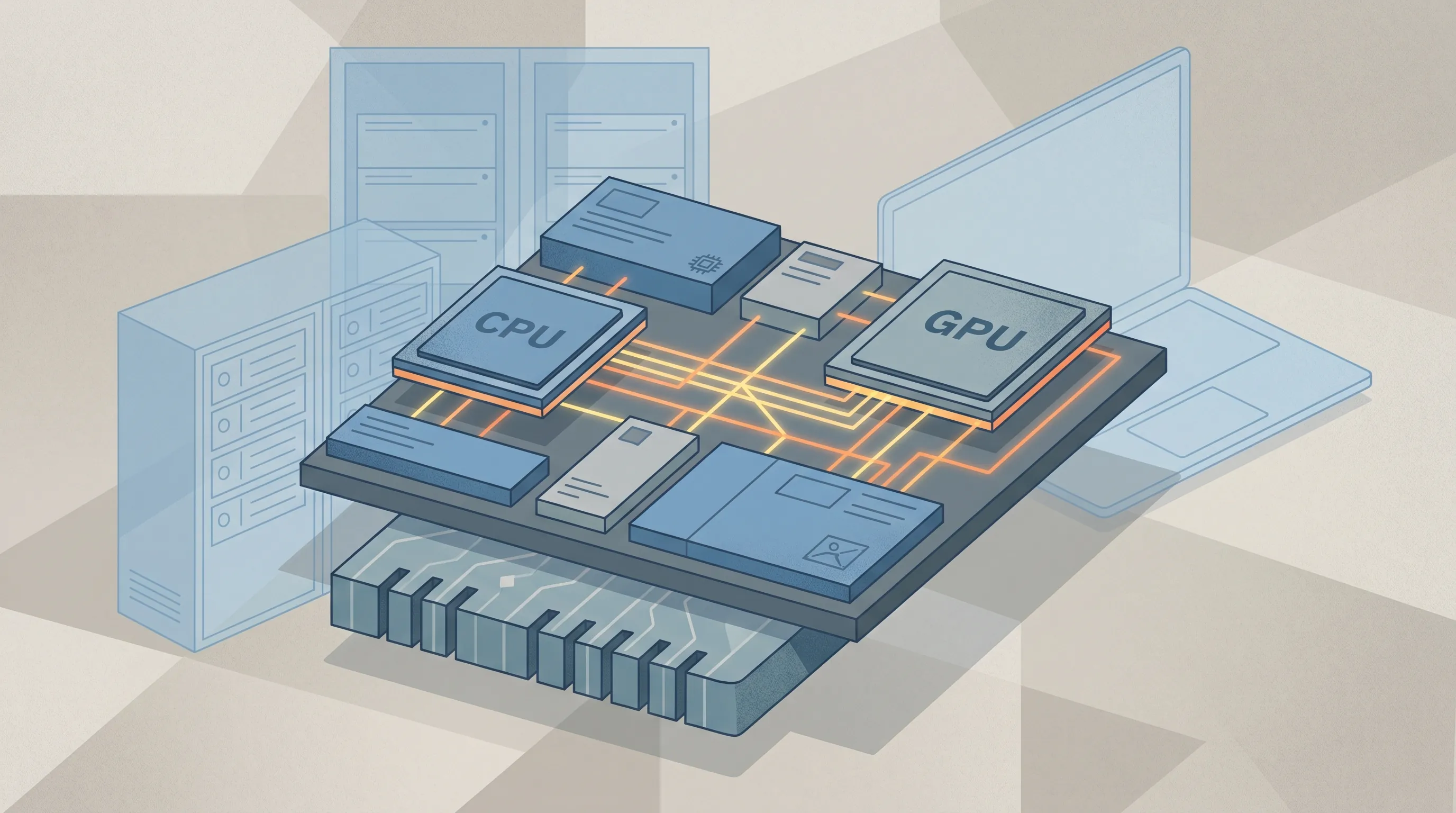
An illustration depicts a stylized circuit board with glowing lines connecting CPU and GPU chips alongside faint server and laptop outlines. © The GPU Trade Inc 2026
Intel chairman Lip‑Bu Tan publicly suggested his company and NVIDIA are working together on new products during a Carnegie Mellon University ceremony in early May 2026, a remark that revived industry talk about tightly coupled CPU‑GPU designs.
The exchange came as Tan crowned NVIDIA CEO Jensen Huang with an honorary doctorate at Carnegie Mellon’s commencement on May 10, 2026 — and then posted a public congratulation that included the line, “Intel and NVIDIA are collaborating to develop exciting new products.”
Tan’s short public note on X amplified conversations that had already been circulating inside chip and OEM circles since last year, when the companies disclosed a broad strategic tie‑up. Industry watchers said the timing and setting — a high‑profile academic ceremony — made the message louder than a routine press release.
The Intel–NVIDIA relationship is not new. In September 2025 NVIDIA committed a roughly $5 billion strategic investment in Intel and the two firms announced a multi‑generation partnership to co‑develop CPUs and hybrid packages for data centers and client devices. The investment and framework were confirmed in company filings and public statements at the time.
What Tan said this month matters because the technical work to bind CPU and GPU tiles together already exists — and it is dominated by packaging, interconnects and system‑level design rather than by single‑die transistor counts. Advanced packaging lets companies combine dies built on different process nodes into one coherent part.
Two packaging approaches named most often in industry writeups are Intel’s Foveros stacking and EMIB bridges. Those technologies let an x86 CPU tile sit next to, or atop, a GPU tile with high‑bandwidth, short‑latency links. NVIDIA’s NVLink protocol is the obvious candidate for chip‑to‑chip coherence inside such packages. Analysts say that pairing changes where performance gains come from — at the package and interconnect level, not purely from raw GPU die performance.
Market chatter since the partnership announcement has sketched two obvious product families: custom Xeon‑class CPUs that speak NVIDIA’s NVLink for AI host nodes, and client SoCs that pair Intel x86 cores with NVIDIA RTX‑class GPU tiles for thinner, more power‑efficient laptops and PCs. Those plans remain at differing stages of confirmation and some details are still speculative.
OEMs and hyperscalers are watching closely because a co‑designed CPU/GPU package would change system architecture decisions. For data centers, a coherent host CPU with NVLink could reduce the bottlenecks that come from moving data across PCIe to discrete accelerators. For laptops, tightly integrated GPU tiles could offer higher sustained performance in smaller thermal envelopes. Independent reviewers caution, however, that thermals, drivers, and ecosystem integration are nontrivial hurdles.
The commercial and strategic stakes go beyond product specs. Intel wants to show that its advanced packaging and manufacturing roadmap make it a valuable systems partner, and NVIDIA gets a pathway to broaden where its GPU IP appears without giving up the performance advantages of its chosen foundries. The tie‑up also feeds debate about whether today’s semiconductor competition is shifting from pure process nodes toward package‑level system design.
Not everyone expects a sudden flood of finished products. Packaging scale‑up, qualification, BIOS/firmware and OS integration can add many months to development timelines. Reports and analyst timelines have ranged from late 2026 rollouts for some client parts to 2027 or beyond for larger AI‑class packages — dates that depend on manufacturing yields and thermal design work. Until OEMs ship complete platforms, much of the discussion will remain informed speculation.
The headlines matter for rivals too. AMD’s integrated APUs and ARM‑based server efforts suddenly face a competitor that could offer NVLink‑connected x86 hosts or tightly integrated RTX‑branded client SoCs, if Intel and NVIDIA deliver on the joint designs. That prospect has already reshaped OEM conversations about platform roadmaps and parts sourcing.
For now the clearest takeaway is simple: Lip‑Bu Tan’s public comment at Carnegie Mellon on May 10, 2026, rekindled a conversation that began with a formal strategic deal in 2025 and now sits where engineering, packaging, and market design intersect. Watch for incremental product disclosures, OEM design wins, and packaging milestones rather than a single blockbuster announcement.