Venice's 70% Leap Reshapes Server Refreshes
Independent tests and vendor materials claim big generational gains that could speed cloud migrations
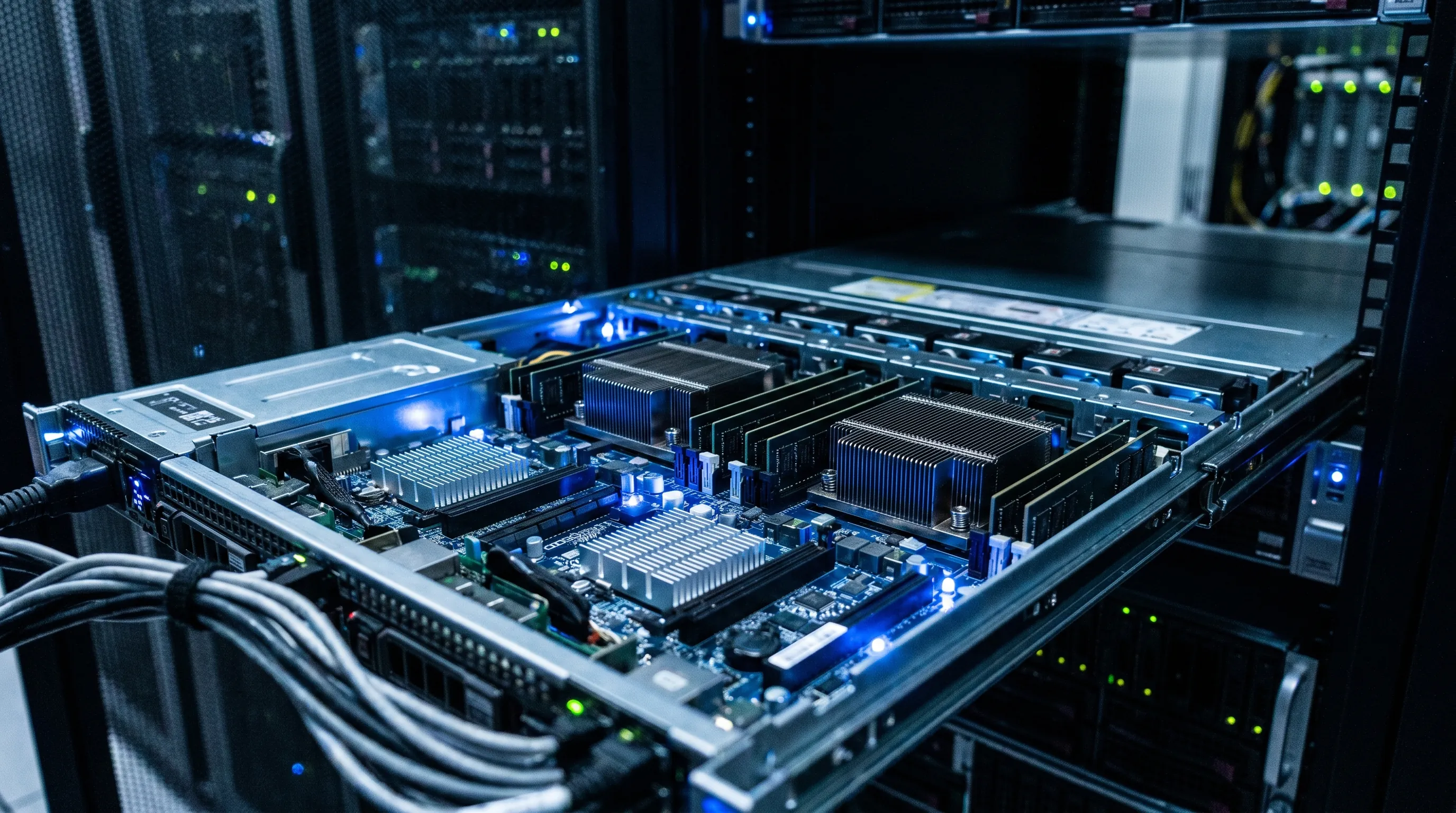
A partially extracted server chassis in a data center rack reveals internal hardware including a motherboard, heat sinks, and memory modules. © The GPU Trade Inc 2026
AMD’s next-generation EPYC server processor, codenamed Venice, has entered production on TSMC’s 2nm-class process and is being touted by vendors and early writeups as delivering up to roughly 70% higher performance versus the prior-generation Turin parts.
That headline number — “up to ~70%” — appears repeatedly in AMD materials and in early press coverage, and independent outlets have reported similar uplifts in specific AI and HPC workloads that vendors highlighted during the Venice ramp.
AMD and partners frame Venice as an AI- and HPC-focused design built on a Zen 6 architecture scaled to as many as 256 cores, with a claimed increase in thread density and a substantial boost in memory bandwidth versus the prior generation. Those framing details are present in AMD’s own statements and in the vendor briefings that accompanied the production announcement.
The move to TSMC’s N2 node brings gate-all-around (GAA) nanosheet transistors and node-level efficiency gains that vendors say help unlock Venice’s performance. TSMC has described early N2 yields and performance advantages, which AMD and observers cite when explaining how Venice achieves both higher throughput and improved power efficiency.
Independent benchmark reports and early writeups — including Tom’s Hardware and TechSpot — show workload-dependent uplifts, with some synthetic and real-world AI/HPC tests reporting gains large enough to alter total cost of ownership math for data centers. Those publications stress the variance across benchmarks and the importance of configuration, but their coverage helped the “70%” figure gain traction.
Analysts and industry commentators say that if those generational gains hold up at scale, hyperscalers and cloud providers could accelerate migration plans and compress typical server refresh timelines, because a single Venice platform may deliver materially more AI throughput per rack. Analyst commentary published alongside the rollout makes that case.
A practical consequence market watchers flag is intensified demand for next-generation memory and interconnect technologies. Venice’s higher core counts and claimed increases in memory bandwidth put pressure on HBM and advanced DIMM roadmaps, and on chip-to-chip interconnect capacity inside racks. Vendors and analysts note those upstream supply chains will matter to how quickly deployments scale.
That said, outlets and benchmarkers caution against reading the top-line percentage as a universal uplift. Gains in AI model training, inference, or HPC simulations depend heavily on software stack optimizations, memory subsystem configuration, and the mix of CPU versus accelerator work done in a given cluster. Early public numbers tend to target scenarios favorable to the new architecture.
Supply and ramp timing also shape real-world impact. AMD’s announcement says production has started in Taiwan with plans for broader capacity, and coverage notes TSMC’s N2 capacity expansion as a supporting factor, but commercial shipments and broad OEM system availability will dictate when data-center operators can actually reorder at scale.
For cloud and hyperscale operators the calculus is both technical and logistical. If Venice reliably delivers the vendor-claimed IPC and throughput gains in their own mixed workloads, replacement cycles that historically ran three to five years could shorten as providers chase density and power-efficiency wins that directly affect operating costs. Several analysts outlined that scenario in early reactions to the Venice announcement.
Hardware vendors and ODMs are already positioning Venice-based platforms for AI racks and HPC clusters, pairing the CPUs with faster memory and denser networking to showcase end-to-end throughput. Early system designs emphasize balanced platform bandwidth and cooling to let Venice reach its performance targets in sustained workloads.
Bottom line: Venice’s combination of a 2nm process, Zen 6 architectural changes, and vendor-tuned platform configurations is being reported as a sizable generational step for select AI and HPC workloads. But independent reviewers, cloud operators, and supply-chain realities will determine how broadly that 70% figure matters to enterprise refresh plans and to demand for next‑gen memory and interconnects.